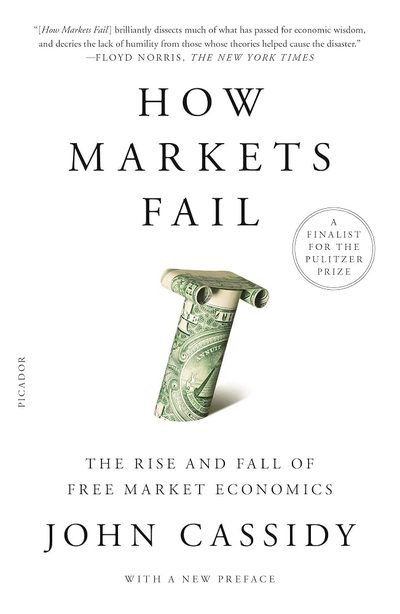
How Markets Fail: The Logic of Economic Calamities by John Cassidy

How Markets Fail: The Logic of Economic Calamities

by John Cassidy

View on Goodreads

At their best, markets let people trade to mutual benefit, the ideal economists call Pareto efficiency. That said, Cassidy's case is that an idealized model of self-correcting markets came to dominate economics and policy, and you see where that led in the housing bubble, as individually rational choices added up to the 2008 collapse.

Core ideas
  • Utopian economics: From Adam Smith to Milton Friedman and Alan Greenspan, theory assumed rational actors and perfect information, and Greenspan treated markets as inherently stable.
  • Reality-based economics: Keynes, the prisoner's dilemma, behavioral economics and Hyman Minsky's work on financial instability explain the crash far better than the idealized model.
  • Crony capitalism: Easy money plus deregulation wasn't a genuine free market, he argues, and mortgage lenders exploited their information advantage over borrowers.
Published2009
Pages400
ISBN9780374173203

Connected to 11 other books

See the connection map
The Lords of Easy Money: How the Federal Reserve Broke the American Economy by Christopher Leonard The Lords of Easy Money Christopher Leonard Read May 2026 When the Fed creates money, you'd assume it reaches the economy you live in. The Quants: How a New Breed of Math Whizzes Conquered Wall Street and Nearly Destroyed It by Scott Patterson The Quants Scott Patterson Read Jan 2026 When every fund's model points to the same trade, you don't have diversification anymore, you have a crowd. How Countries Go Broke: The Big Cycle (Principles) by Ray Dalio How Countries Go Broke Ray Dalio Read Jun 2025 Can the country that issues the world's reserve currency in effect default? Trillion Dollar Triage: How Jay Powell and the Fed Battled a President and a Pandemic---and Prevented Economic Disaster by Nick Timiraos Trillion Dollar Triage Nick Timiraos Read Jun 2024 In February 2020 unemployment sat at a 50-year low, and then lockdowns wiped out more than 22 million jobs as markets plunged. The Psychology of Money: Timeless Lessons on Wealth, Greed, and Happiness by Morgan Housel The Psychology of Money Morgan Housel Read Aug 2023 Morgan Housel's case is that doing well with money depends more on how you behave than on what you know. Debt: The First 5,000 Years by David Graeber Debt David Graeber Read Jul 2023 The barter story sounds sensible, and economists have told it since Adam Smith. The Lost Bank: The Story of Washington Mutual-The Biggest Bank Failure in American History by Kirsten Grind The Lost Bank Kirsten Grind Read Mar 2023 The largest bank failure in American history, and before it, a well-regarded regional lender that grew into a sprawling mortgage… 1929: Inside the Greatest Crash in History – and How It Shattered a Nation by Andrew Ross Sorkin 1929 Andrew Ross Sorkin Read Oct 2025 On October 28, 1929, the market fell about 13 percent, and National City Bank found itself holding some 71,000 shares from a… Why Nations Fail: The Origins of Power, Prosperity, and Poverty by Daron Acemoğlu Why Nations Fail Daron Acemoğlu Read Oct 2024 Similar people, very different outcomes: North and South Korea are Acemoğlu and Robinson's central illustration. A Little History of Economics by Niall Kishtainy A Little History of Economics Niall Kishtainy Read Feb 2024 From Plato and Aristotle to Piketty, Stiglitz and Sen, in about 40 short chapters, each built around a thinker or a concept. The Lords of Creation: The History of America's 1 Percent (Forbidden Bookshelf) by Frederick Lewis Allen The Lords of Creation Frederick Lewis Allen Read Jun 2023 Between the depression of the 1890s and the crash of 1929, American financiers and industrial capitalists built a huge corporate…